2025 PX4 Deveoper Summit Review – Part.1: Keynotes
The Open Source Shortcut That Isn’t: 4 Hard-Won Truths for Developers
In the fast-paced world of software development, the pressure to move fast is relentless. When you’re building on top of a powerful open-source project, the temptation is to take what seems like a shortcut: fork the code, stabilize it for your specific needs, and get back to shipping features. It feels pragmatic, efficient, and safe. But what if that shortcut is actually the longest, most costly path you can take?
This isn’t a theoretical question. It’s the central lesson from the journey of Jacob Dahl. In 2017, Dahl was an electrical engineering graduate who “barely knew how to code.” But he found a community, and in that community, a mentor named Daniel Agar, who would answer his questions and review his code. Today, Dahl is a maintainer and top contributor to PX4, one of the world’s most advanced open-source flight control systems. His journey from novice to expert revealed a series of counter-intuitive truths about working with open-source software—lessons that challenge the conventional wisdom of many engineering teams.
This is the story of how engaging deeply with an open-source community can transform a career, a team, and a product. It’s about the surprising and impactful lessons learned from choosing the harder path and discovering it was the right one all along.
The “Shortcut” Is the Longest Path
The strategy is known as “fork and stabilize” or, more accurately, “fork and forget.” For a development team under pressure, the logic is seductive. By freezing your codebase on a stable release, you save time. You aren’t spending hours every week reviewing upstream changes, you’re not dealing with new bugs introduced by others, and you’re not testing against a moving target. It provides a stable foundation to build upon, and in the short term, the development velocity is undeniable.
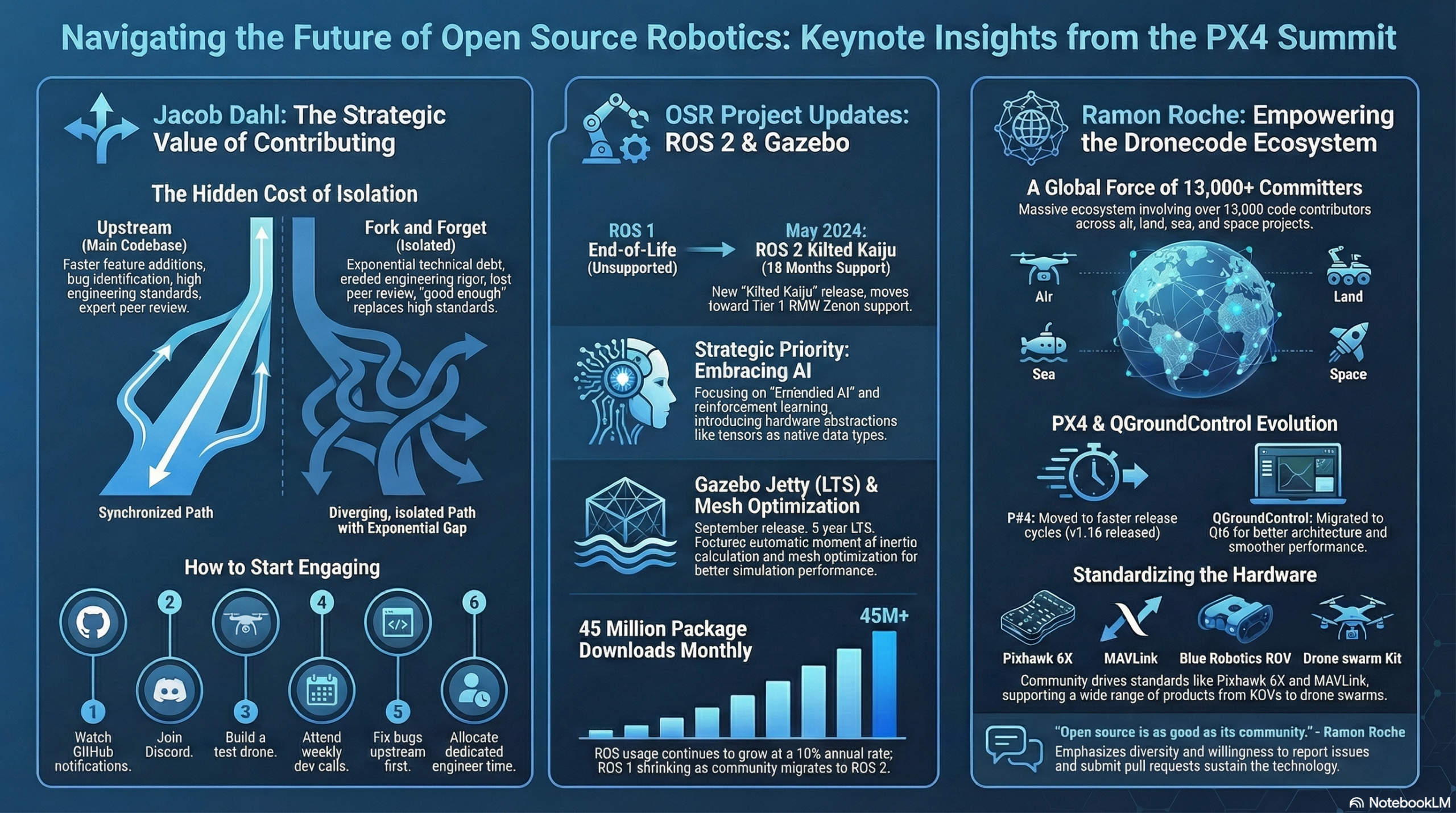
The problem, as Jacob Dahl learned the hard way, is that the gap between your fork and the main project grows “not linearly, exponentially.” What starts as a small divergence becomes a chasm. This isn’t just about technical debt; it’s about real-world consequences. Dahl recalls the single worst mistake his team made: shipping hardware with work-in-progress Mavlink messages. The customer had deadlines and didn’t care about receiving prototype code. The hardware was deployed, but the message definitions upstream eventually evolved. It was too late. The customer had already built on the prototype, and worse, another partner had developed an entire app against those same prototype messages. To update now would mean coordinating changes across multiple companies and an entire fleet. The result? They were forced to continue shipping hardware with the prototype messages, creating a permanent need for “translation layers.” As Dahl puts it, “one rush shipment resulted in permanent problems.”
so we had dug ourselves a hole we had chosen speed over sustainability and in the end what we thought was the shortcut ended up being the longest path
Isolation Erodes Your Skills
The most obvious cost of maintaining an isolated fork is technical debt. You can’t consume the latest improvements, you can’t get help from maintainers, and you’re stuck supporting your own custom integrations. But Dahl discovered a far more insidious cost: the erosion of engineering rigor.
When you work in isolation, your code doesn’t receive the same level of scrutiny. There’s no Bakun reviewing your driver changes, there’s no Daniel Agar pushing back on your architectural choices. Without that constant feedback loop from a community of peers, the quality of your code begins to drift. “Good enough for the customer becomes good enough for you.” Dahl watched his own standards slip as he started to make compromises and cut corners to meet deadlines. The process itself removes the very guardrails that keep engineers sharp.
and here’s the thing I realized how you do one thing is how you do everything when you make exceptions in one area when you say just this once or we don’t have time becomes easier to make those exceptions everywhere
Contributing Isn’t Charity, It’s Your Competitive Advantage
There is a common misconception that contributing to open source is an act of charity—a “nice to have” activity for engineers to do on the weekends if they have time. This view fundamentally misunderstands the value of participation. Engaging with the upstream project isn’t a donation of your time; it’s a strategic investment in your own success. Every bug you fix upstream is one less bug your customers hit down the road. Every feature you push is one less feature you have to maintain in your fork.
Dahl argues that active contribution delivers clear, tangible benefits that create a powerful competitive advantage.
- Build relationships: When you hit critical issues, the core developers know who you are. They are far more likely to help you debug a problem when they recognize you as a fellow contributor.
- Stay ahead of the churn: By participating in code reviews and discussions, you help maintain the quality of the project you depend on. You catch bugs before they ever make it into a release, strengthening the foundation your product is built on.
- Build your reputation: Active participation demonstrates deep expertise. You can deliver faster resolutions to your customers, provide them with strong technical explanations, and give them confidence that you know what you’re doing.
this isn’t charity this is the most strategic thing you can do to secure your company’s future contributing isn’t some nice to have activity or something that you do on the weekends it’s the choice that separates those who use technology from those who shape it
Engagement Starts Small
The idea of becoming a contributor can be intimidating, especially on a large, complex project. But you don’t have to start by architecting a major new feature. The journey from user to contributor is built on small, consistent actions.
Jacob Dahl offers a simple, practical guide for anyone looking to get started:
- Watch the project on GitHub: Click the “watch” button. You’ll get a lot of email notifications, so filter them into a dedicated folder. Skim them once or twice a week to get a feel for the project’s direction and active issues.
- Get on the community chat (e.g., Discord): This is where the real-time conversation happens. Browse discussions, ask your own questions, and if you see a question you can answer, lend a hand.
- Build a simple test platform: Get a small development drone or system just for testing upstream code. This creates a bridge between your stable production system and the bleeding edge of the project.
- Show up to the weekly dev call: You don’t have to talk. Just listen. Understanding the maintainers’ priorities is invaluable context.
- Reverse your development process: The next time you fix a bug in your product, fix it upstream first. Then, cherry-pick that commit back into your own fork. Each time you do this, you close the gap instead of widening it.
- Allocate dedicated time: Make community engagement an official part of your engineering schedule. This isn’t something to be done “when they have time.” It’s core work.
These small, consistent actions are the foundation for deep and impactful participation, gradually transforming you and your team from passive consumers to active collaborators.
Conclusion: Are You a User or a Shaper?
The journey from the outside to the inside of an open-source community reveals a fundamental truth: active participation is not a burden. It is a powerful mechanism for personal growth, team excellence, and sustainable business success. The “shortcut” of isolation leads to technical debt and stagnation, while the path of engagement leads to stronger skills, better products, and a more secure future.
As Dahl notes, projects like PX4 are built by hundreds of engineers across different companies and countries, creating something none could build alone. But it only works if people participate. If everyone takes and no one gives back, the project dies—not overnight, but gradually. As Dahl warns, “the maintainers burn out, the codebase degrades, and eventually the foundation that you built your business on crumbles.”
Looking at your own projects, are you simply using the technology, or are you helping to shape it?
![PX4 MAVSDK – C++ Programming [5편] 시스템 정보 쿼리 및 원격 측정(Telemetry) 활용](https://quad-drone-lab.co.kr/wp-content/uploads/2026/03/0315_인포그래피-768x512.png)
![PX4 MAVSDK – C++ Programming [7편] 특정 위치로 이동 (goto_location) 및 하버사인 공식의 이해](https://quad-drone-lab.co.kr/wp-content/uploads/2026/03/0317_인포-768x512.png)
![PX4 MAVSDK – C++ Programming [Part 9] Precision Drone Control: Offboard Mode](https://quad-drone-lab.co.kr/wp-content/uploads/2026/03/0319_인포그래픽-768x429.jpg)
![PX4 MAVSDK – C++ Programming [6편] Action API를 이용한 기본 비행 제어](https://quad-drone-lab.co.kr/wp-content/uploads/2026/03/0316_인포그래피-768x512.png)