[New Blog Series Introduction] Everything About Drone Batteries – From Basics to Next-Generation Technologies
Hello to all the graduate students and researchers dedicating yourselves to the research and development of drones and next-generation air mobility (UAM, eVTOL)!
When discussing drone performance, the ‘battery’ is an absolutely indispensable core component. To increase the aircraft’s payload and maximize flight time, a deep understanding of battery chemical characteristics, high-voltage design, and sophisticated Battery Thermal Management Systems (BTMS) is essential, going beyond a simple increase in capacity.
In this blog series, we will delve deeply into everything about drone batteries, dividing the topic into 5 parts, ranging from basic design in the lab to the latest technologies in actual industrial and commercialization stages. Please take a sneak peek at the core contents of each upcoming part.
📝 Overall Series Table of Contents & Key Content Summary
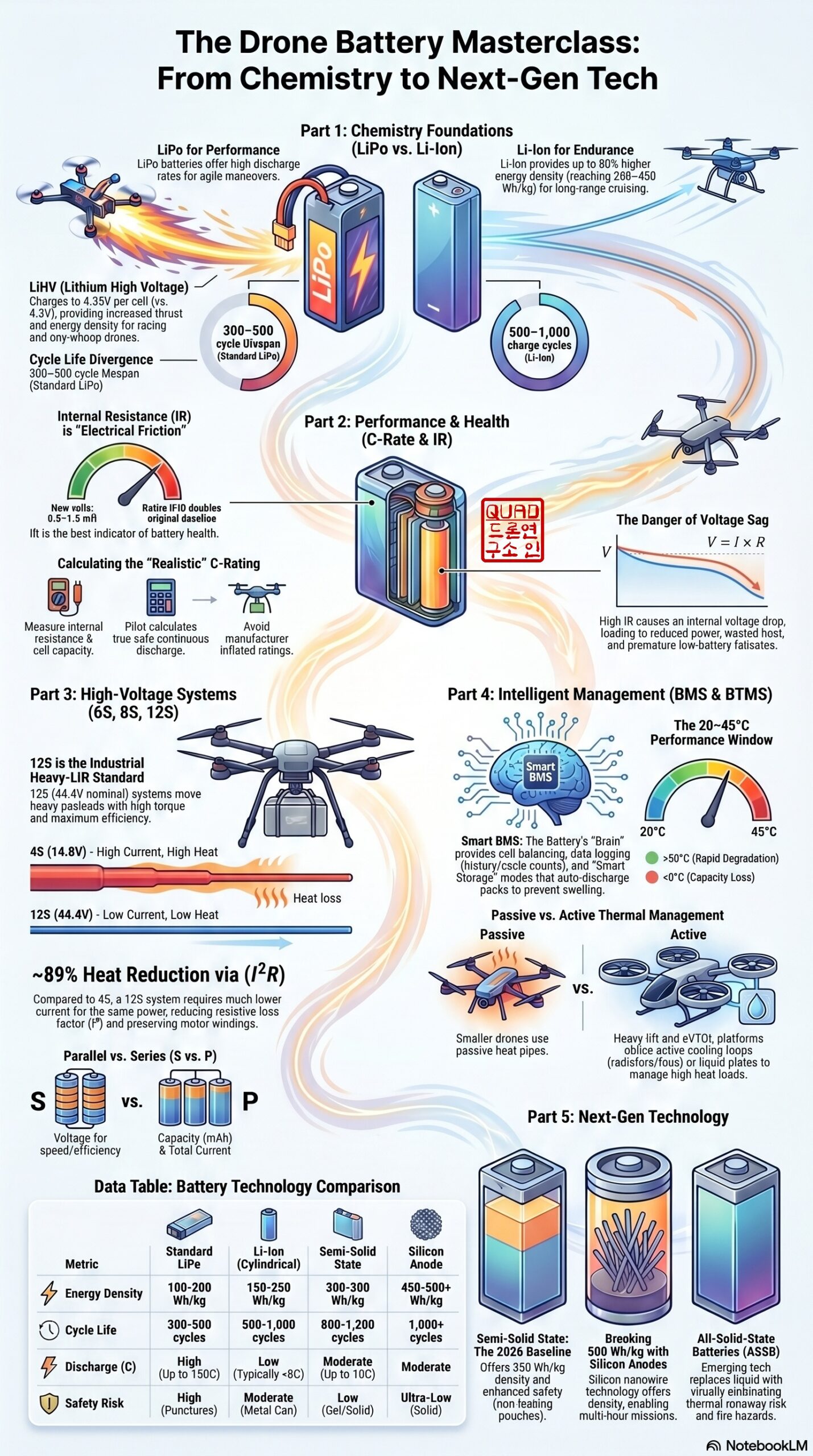
Part 1: Basics and Chemical Characteristics of Drone Batteries: LiPo vs. Li-Ion The series kicks off by analyzing the principles of Series (S) and Parallel (P) configurations—the backbone of drone batteries—and the differences between Lithium Polymer (LiPo) and Lithium-Ion (Li-Ion) batteries, which currently divide the market. We will compare the chemical characteristics of LiPo batteries, which boast an explosive punch (discharge rate), and Li-Ion batteries, which are advantageous for long endurance by maximizing energy density through cylindrical cell structures like 21700. We will also directly design the optimal pack configuration suitable for research purposes through Python simulations.
Part 2: Key Indicators Determining Flight Performance: Discharge Rate (C-Rating) and Internal Resistance (IR) Often, the discharge rate (C-Rating) listed on a battery’s spec sheet is exaggerated. In the second part, we will dig into the principles of Internal Resistance (IR), the most definitive indicator of battery State of Health (SOH). We will explore how an increase in internal resistance causes voltage sag during rapid throttle maneuvers, and learn how to calculate the practical maximum continuous discharge rate of a pack based on measured IR values. We will also cover the importance of maintaining the correct storage voltage to prevent degradation.
Part 3: Evolution to High-Voltage Systems: The World of 6S, 8S, and 12S Beyond the transition from 4S (14.8V) to 6S (22.2V) in small drones, high-voltage systems of 8S (29.6V) and 12S (44.4V) or higher are now becoming the standard for industrial and medium-to-large drones. In the third part, we will analyze how a high-voltage (12S) system reduces current consumption by more than half while producing the same power, thereby decreasing the thermal and mechanical stress on the motors and Electronic Speed Controllers (ESCs), and how this leads to long-term maintenance cost reductions. We will also cover practical design examples of an 8S4P configuration utilizing next-generation high-output cells like the Molicel P45B.
Part 4: Enduring the Extremes: Thermal Management (BTMS) and Smart BMS Technology No matter how good a cell is, failing in thermal management leads to thermal runaway. In this part, we will review research trends in active and passive cooling techniques currently gaining attention, such as Phase Change Materials (PCM) and Direct Liquid Cooling technologies. In addition, we will deeply cover the core functions of an intelligent Battery Management System (Smart BMS) that extends lifespan, such as real-time logging of voltage, current, and temperature for each cell, and automatically discharging to storage voltage when left unused for more than 5 days.
Part 5: Breaking the Limits of Flight Time: Semi-Solid, All-Solid-State, and Silicon Anodes In the final part, we will forecast next-generation battery technologies that have begun commercialization. We will examine the structural advantages (dendrite suppression through electrolyte gelation and reduced fire risk) of Semi-solid State batteries from brands like Tattu, which have drastically increased flight times by over 30% with an overwhelming energy density reaching 300-380Wh/kg. Furthermore, we will look into how Amprius’s Silicon Nanowire anode technology—which achieved an energy density of 400-450Wh/kg and a discharge rate of 10C by replacing traditional graphite anodes—will innovate the future eVTOL and High-Altitude Platform Station (HAPS) UAV markets.
Researchers, are you ready? We hope this series provides you with valuable insights to take your drone system design to the next level. Whether you need to select battery specifications right away or are preparing a paper on thermal management systems, please be sure to check out the upcoming main articles!

Author: maponarooo, CEO of QUAD Drone Lab
Date: April 21, 2026
![[ROS2 Mastery Part 5] ROS2 Topic Programming (2) – Receiving Location Information with a Subscriber](https://quad-drone-lab.co.kr/wp-content/uploads/2026/05/0516_인포그래피-768x429.jpg)