[Everything About Drone Batteries] Part 1: Drone Battery Fundamentals and Chemical Characteristics: LiPo vs. Li-Ion
Hello to all the graduate students and researchers dedicating yourselves to the advancement of drones and next-generation air mobility (UAM, eVTOL)! Welcome to the first installment of our deep-dive series on the most critical, yet arguably the most challenging, component of drone design: the Battery.
As the mission scopes of drones expand from simple hobbyist applications to logistics, mapping, agriculture, and military surveillance, energy density and discharge rates have become the primary bottlenecks determining mission success. In today’s post, we will explore the foundational architecture of drone batteries—understanding Series (S) and Parallel (P) configurations—and conduct a thorough chemical and physical comparison between the two dominant power sources in the industry: LiPo (Lithium Polymer) and Li-Ion (Lithium-Ion) batteries.
We will walk you through the theoretical backgrounds step-by-step, and even provide a Python simulation code that you can easily adapt for your own research modeling. Let’s dive in!
1. The Backbone of Drone Battery Design: Principles of Series (S) and Parallel (P)
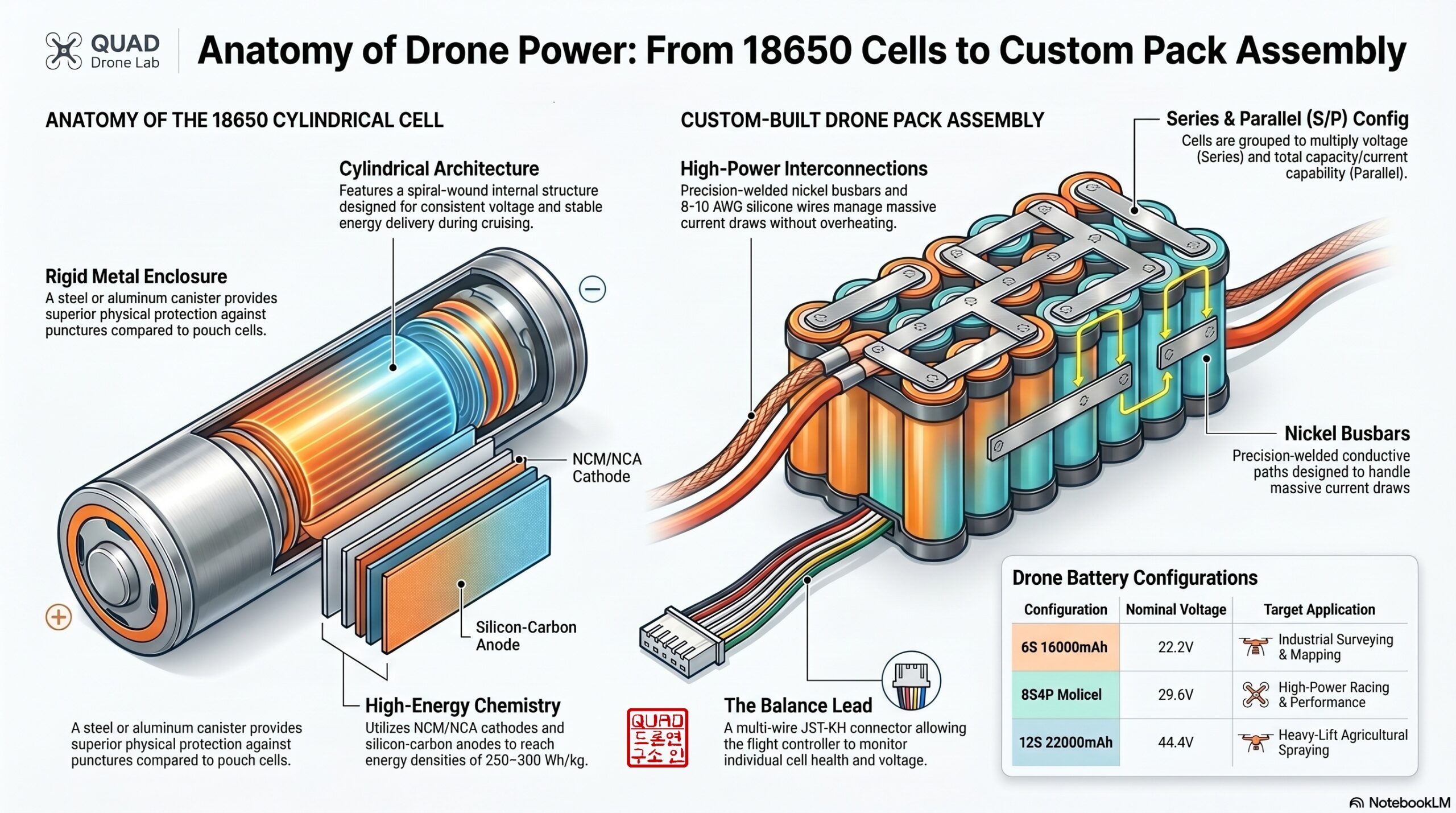
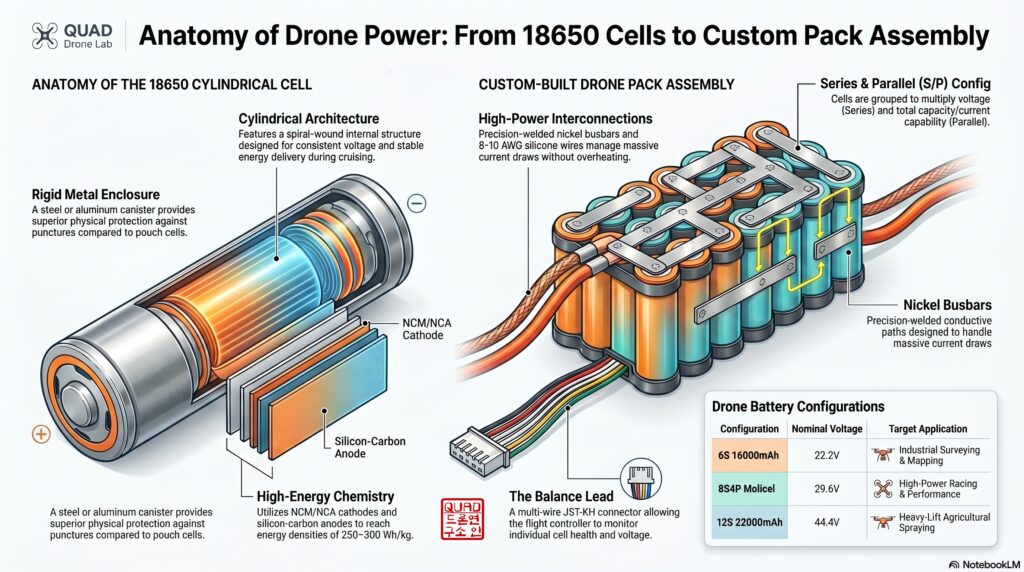
When looking at drone battery specifications, you will often encounter terms like “6S 16000mAh” or “8S4P”. These seemingly cryptic numbers define the electrical foundation of your power system. ‘S’ stands for Series, and ‘P’ stands for Parallel.
- Series (S) – Determining Voltage: The nominal voltage of a standard lithium-based cell is typically around 3.7V. Connecting cells in series multiplies the total voltage of the pack. For instance, a 6S battery has 6 cells connected in series, resulting in a nominal voltage of 22.2V (3.7V × 6) and a fully charged voltage of 25.2V (4.2V × 6). A 12S battery provides 44.4V nominal. Voltage is directly tied to the motor’s RPM. Crucially, achieving the same power output at a higher voltage requires lower current, which drastically reduces resistive heat generation and allows for lighter wire gauges, significantly boosting overall system efficiency.
- Parallel (P) – Determining Capacity and Current: Connecting cells in parallel keeps the voltage constant but multiplies the capacity (mAh or Ah) and the maximum current discharge capability. For example, an 8S4P configuration means 8 cells in series and 4 parallel branches, totaling 32 cells. If one cell can handle 45A, four in parallel can deliver a massive 180A of continuous current.
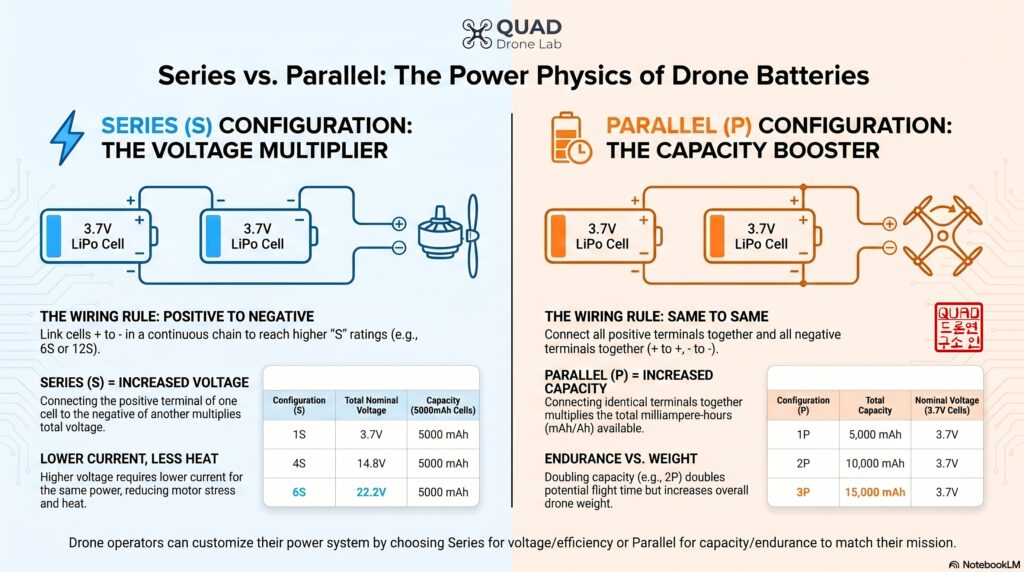
When designing a drone for your research, you must constantly balance payload limits and thrust requirements. The decision of whether to increase voltage for efficiency or increase parallel cells for longer flight times begins here.
2. The Symbol of Explosive Punch: LiPo (Lithium Polymer) Batteries
Currently, LiPo (Lithium Polymer) batteries are the undisputed kings for FPV racing drones, aerial cinematography, and heavy-lift agricultural platforms.
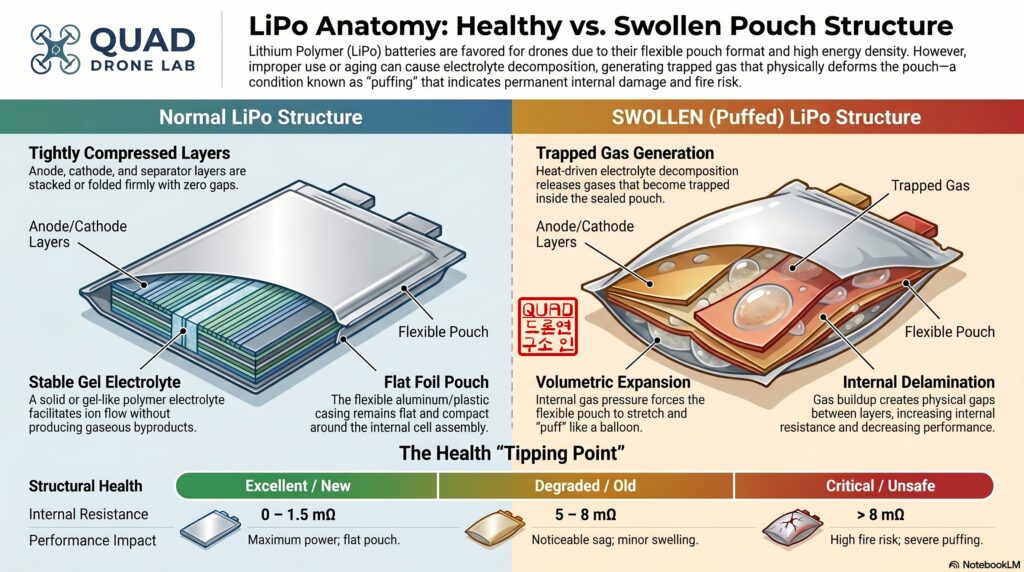
[Chemical and Physical Characteristics] Unlike traditional liquid electrolytes, LiPo batteries utilize a polymer or gel-like electrolyte. This allows them to be packaged in flexible, lightweight “pouch” forms rather than rigid metal casings, providing immense flexibility in shape and weight reduction.
[The Advantage: Overwhelming Discharge Rate (C-Rating)] The greatest strength of a LiPo battery is its ability to release energy explosively—known as the discharge rate or C-rating. During aggressive maneuvers or rapid ascents, drones demand massive current spikes. LiPo batteries excel here, capable of delivering burst currents up to 50C to 150C. Thanks to their remarkably low internal resistance, they suffer from minimal voltage sag under heavy load, maintaining consistent motor RPM and stability.
[The Disadvantages: Safety and Lifespan] However, the soft pouch design makes them vulnerable to physical punctures and crashes. Furthermore, LiPos are highly sensitive to abuse. If overcharged, over-discharged, or overheated, the electrolyte decomposes and generates gas, causing the battery to swell or “puff” up like a balloon. Operating a swollen battery or exposing it to extreme heat greatly increases the risk of thermal runaway and fire. Additionally, their cycle life is relatively short, typically degrading noticeably after 150 to 500 charge cycles depending on usage.
3. The Secret to Maximum Endurance: Li-Ion (Lithium-Ion) Batteries
For applications where endurance is the ultimate goal—such as long-range fixed-wing UAVs, border surveillance, autonomous mapping, and delivery drones—Li-Ion (Lithium-Ion) batteries are rapidly taking over.
[Chemical and Physical Characteristics] Lithium-Ion batteries commonly utilize a liquid electrolyte housed inside rigid, cylindrical metal canisters, with the 18650 and 21700 formats being the most popular. This metal casing makes them far more robust against physical impacts and internal pressure compared to LiPo pouches.
[The Advantage: Supreme Energy Density and Longevity] The defining characteristic of Li-Ion is its energy density. While standard LiPos offer around 100-200 Wh/kg, modern Li-Ion cells boast energy densities of 150-450 Wh/kg. Even though the metal casing adds some weight, the immense capacity-to-weight ratio allows drones to achieve 20% to 30% longer flight times. Moreover, they boast an excellent cycle life, easily surviving 500 to 1,000 charge cycles with minimal capacity degradation, making them highly economical for commercial fleets.
[The Disadvantages: Voltage Sag and Current Limits] The trade-off for this high capacity is a higher internal resistance. Li-Ion batteries struggle with high peak current demands and rapid throttle changes. If you demand too much current too quickly, the voltage will sag significantly, triggering low-battery warnings or causing a loss of thrust. Therefore, they are perfectly suited for “cruising” but poor for acrobatics or heavy, dynamic payloads.
4. Summary: Which Battery Should I Choose?
To help you quickly select the right battery chemistry for your specific research or application, here is a concise comparison:
| Feature | LiPo (Lithium Polymer) | Li-Ion (Lithium Ion) |
|---|---|---|
| Form Factor | Flexible Soft Pouch | Rigid Cylindrical Metal Canister (e.g., 18650) |
| Energy Density | Moderate (100 – 200 Wh/kg) | Very High (150 – 450 Wh/kg) |
| Discharge Rate | Extremely High (Excellent for bursts) | Low to Moderate (Prone to voltage sag under high load) |
| Cycle Life | ~ 300 – 500 cycles | **~ 500 – 1,000 cycles** |
| Best Applications | FPV Racing, Cinematic Heavy-lifters, Ag-Spraying | Long-range Surveillance, Mapping, Delivery |
(Tip for Researchers: Always ensure your chosen pack’s continuous discharge rating comfortably exceeds your drone’s maximum current draw to prevent dangerous overheating and voltage collapse.)
5. Python Simulation: Battery Specs & Flight Time Estimation
For the graduate students designing custom UAVs, calculating pack specifications from individual cell datasheets is a frequent task. Below is a Python script that takes cell-level data and your chosen Series/Parallel configuration to estimate total pack weight, energy density, and theoretical flight time.
class DroneBatteryPack:
    def __init__(self, chemistry, cell_voltage, cell_capacity_ah, cell_weight_kg, series, parallel):
        """
        Initializes the drone battery pack parameters.

        :param chemistry: 'LiPo' or 'Li-Ion'
        :param cell_voltage: Nominal voltage of a single cell (V)
        :param cell_capacity_ah: Capacity of a single cell (Ah)
        :param cell_weight_kg: Weight of a single cell (kg)
        :param series: Number of cells in series (S)
        :param parallel: Number of cells in parallel (P)
        """
        self.chemistry = chemistry
        self.cell_voltage = cell_voltage
        self.cell_capacity_ah = cell_capacity_ah
        self.cell_weight_kg = cell_weight_kg
        self.series = series
        self.parallel = parallel

    def calculate_pack_specs(self):
        """Calculates total voltage, capacity, energy (Wh), and estimated weight."""
        total_voltage = self.cell_voltage * self.series
        total_capacity = self.cell_capacity_ah * self.parallel
        total_energy_wh = total_voltage * total_capacity

        # Adding 15% to account for wires, nickel strips, connectors, and packaging
        total_weight_kg = (self.cell_weight_kg * self.series * self.parallel) * 1.15
        energy_density = total_energy_wh / total_weight_kg

        return {
            "Total Voltage (V)": round(total_voltage, 2),
            "Total Capacity (Ah)": round(total_capacity, 2),
            "Total Energy (Wh)": round(total_energy_wh, 2),
            "Total Weight (kg)": round(total_weight_kg, 2),
            "Energy Density (Wh/kg)": round(energy_density, 2)
        }

    def estimate_flight_time(self, avg_power_consumption_w):
        """
        Estimates flight time based on average power draw.
        Assumes Depth of Discharge (DoD) is capped at 80% for safety.
        """
        specs = self.calculate_pack_specs()
        usable_energy_wh = specs["Total Energy (Wh)"] * 0.8  # Use only 80% of battery
        flight_time_hours = usable_energy_wh / avg_power_consumption_w
        flight_time_mins = flight_time_hours * 60

        return round(flight_time_mins, 2)


# --- Simulation Example ---

# 1. High-Power 6S1P LiPo Pack (e.g., for aggressive FPV)
# Assume: 3.7V per cell, 1.5Ah (1500mAh), 0.04kg per cell
lipo_pack = DroneBatteryPack(chemistry="LiPo", cell_voltage=3.7, cell_capacity_ah=1.5,
                             cell_weight_kg=0.04, series=6, parallel=1)

# 2. Long-Range 6S3P Li-Ion Pack (e.g., 18650 cells for cruising)
# Assume: 3.6V per cell, 3.5Ah (3500mAh), 0.048kg per cell
liion_pack = DroneBatteryPack(chemistry="Li-Ion", cell_voltage=3.6, cell_capacity_ah=3.5,
                              cell_weight_kg=0.048, series=6, parallel=3)

# Assuming average hover power consumption of the drone is 250W
power_draw_w = 250

print(f"=== {lipo_pack.chemistry} Pack Specs (6S1P) ===")
for key, value in lipo_pack.calculate_pack_specs().items():
    print(f"{key}: {value}")
print(f"Estimated Flight Time (@ {power_draw_w}W): {lipo_pack.estimate_flight_time(power_draw_w)} minutes\n")

print(f"=== {liion_pack.chemistry} Pack Specs (6S3P) ===")
for key, value in liion_pack.calculate_pack_specs().items():
    print(f"{key}: {value}")
print(f"Estimated Flight Time (@ {power_draw_w}W): {liion_pack.estimate_flight_time(power_draw_w)} minutes")
By running this script, you can mathematically prove the dramatic difference in flight times between a lightweight LiPo setup and a high-capacity Li-Ion setup. Modify the avg_power_consumption_w variable to match your specific drone’s powertrain!
=== LiPo 배터리 팩 스펙 (6S1P) ===
{'Total Voltage (V)': 22.2, 'Total Capacity (Ah)': 1.5, 'Total Energy (Wh)': 33.3, 'Total Weight (kg)': 0.28, 'Energy Density (Wh/kg)': 120.65}
예상 체공 시간 (250W 소모 시): 6.39 분

=== Li-Ion 배터리 팩 스펙 (6S3P) ===
{'Total Voltage (V)': 21.6, 'Total Capacity (Ah)': 10.5, 'Total Energy (Wh)': 226.8, 'Total Weight (kg)': 0.99, 'Energy Density (Wh/kg)': 228.26}
예상 체공 시간 (250W 소모 시): 43.55 분Conclusion
The ultimate performance of a drone stems from a delicate engineering compromise between chemistry and electronics. The high discharge burst of LiPo and the profound energy density of Li-Ion each serve distinct mission profiles perfectly. To push these boundaries further, the industry is now shifting its focus towards Solid-State Batteries and sophisticated Battery Thermal Management Systems (BTMS).
In [Part 2], we will dive into these next-generation technologies—exploring how solid-state architectures are redefining safety and how thermal management is unlocking new extremes in drone endurance. Keep exploring, and may your flights be long and safe!
YouTube Tutorial

Author: maponarooo, CEO of QUAD Drone Lab
Date: April 21, 2026
![PX4 MAVSDK – C++ Programming [Episode 11] Complete Comparison of MAVSDK vs MAVROS vs uXRCE-DDS](https://quad-drone-lab.co.kr/wp-content/uploads/2026/03/0322_인포그래피-768x512.png)
![[ROS2 Mastery Part 5] ROS2 Topic Programming (2) – Receiving Location Information with a Subscriber](https://quad-drone-lab.co.kr/wp-content/uploads/2026/05/0516_인포그래피-768x429.jpg)
![🎉 [Congratulations] Senior Researcher Geunchan Lee (Leatherneck Dev) Wins the ‘Silver Award’ at Hanyang University’s Creative Comprehensive Design Competition! 🎉](https://quad-drone-lab.co.kr/wp-content/uploads/2026/06/은상수상_20260608_170844072-1-768x1024.jpg)
![[PX4 Autopilot Safety Configuration] Part 1. Pre-Flight Warm-up: Regulations, Flight Location Selection, and Geofencing Guide](https://quad-drone-lab.co.kr/wp-content/uploads/2026/07/Safe_Drone_Flight_Guide-768x429.png)