
The Optimal Platform for Next-Generation AI and V-SLAM Research: In-depth Analysis of QUAD Q250-V3
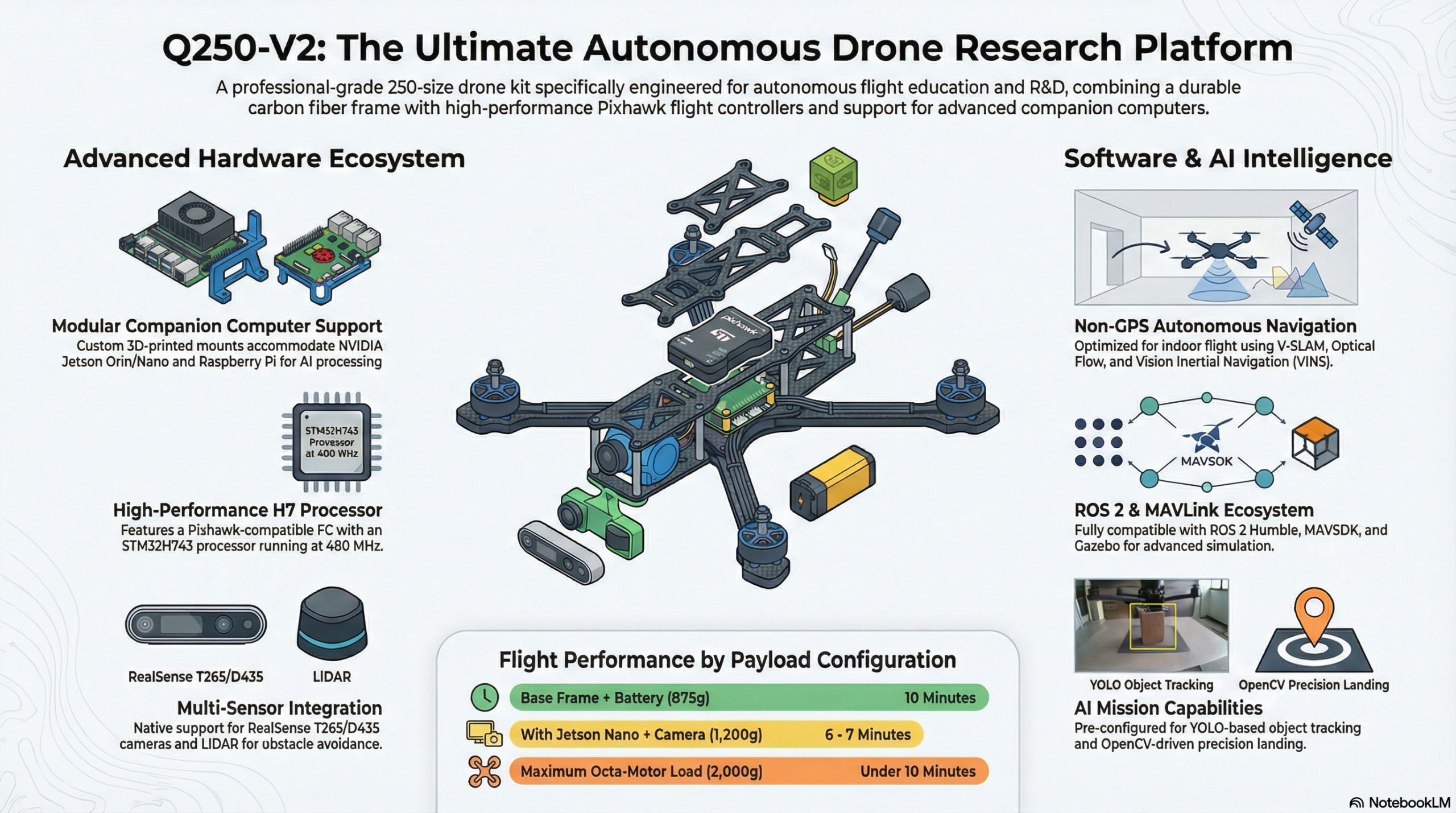
Hello, I am Hyun-soo Ha, a researcher at QUAD Drone Lab. Today, I would like to introduce the Q250-V3 Autonomous Drone Platform, designed to save researchers’ valuable time and allow them to focus solely on their core research achievements.
1. Introduction: Key Challenges in Modern UAV Research and the Necessity of a Platform
Today, Unmanned Aerial Vehicle (UAV) research has shifted its paradigm beyond simple flight control to AI-based situational awareness, autonomous flight in indoor non-GPS environments, and ROS2-based swarm flight. The biggest barriers faced by university labs and corporate R&D centers performing such high-level research are ‘hardware stability’ and the ‘complexity of software integration.’
A researcher’s most valuable asset is ‘time.’ Wasting weeks on Flight Controller (FC) hardware issues or communication settings with companion computers directly leads to a decline in research competitiveness. Therefore, choosing a proven platform optimized for research purposes becomes a deductive prerequisite for success. In this article, I will explain why QUAD Drone Lab’s Q250-V3 should be the standard for modern drone research.
2. Market Analysis: Limitations of Existing Research Platforms and Researcher Requirements
Current research drone platforms on the market target different segments but show clear limitations for the latest AI/V-SLAM research.
| Category | Holybro X500 V2 | Hexoon TD650 (Cube) | NXP HoverGames |
| Main Use | Capstone design, General flight control research, Swarm flight | LiDAR mapping, Logistics delivery experiments, Heavy sensor mounting | Embedded SW education, AI image processing, Coding competitions |
| Recommended FC | Pixhawk 6C / 6X | Cube Orange+ (Built-in ADS-B) | FMUK66 (Dedicated FC) |
| Size/Weight | 500mm / Small to Medium | 650mm / Medium | Under 500mm / Small |
| Difficulty | ★★☆☆☆ (Easy) | ★★★☆☆ (Moderate) | ★★★★☆ (Complex SW Setup) |
| Price Range | Mid (Approx. 0.5-0.8M KRW) | High (Over 1M KRW) | Mid |
As seen in the analysis above, researchers have long craved a high-output platform that offers the agility for both indoor and outdoor use (250mm class) while stably running high-performance AI modules like Jetson Orin.
3. Technical Superiority of Q250-V3 I: Precision in Hardware Design
The Q250-V3 boasts hardware specifications that exceed the limits of existing small drones.
3.1. High-Performance Flight Control and Powertrain
The Q250-V3 is based on a Pixhawk-compatible FC equipped with an H7 processor (STM32H743, 480MHz), the highest specification currently available. This provides ample computational resources while performing complex EKF2/3 filters and real-time Fast Fourier Transform (FFT) vibration control. Additionally, the combination of BrotherHobby high-performance BLDC motors and 65A BLHeli_32 ESCs ensures agile movement even with a takeoff weight of 1.2kg.
3.2. Solder-less Based Rapid Assembly and Maintenance
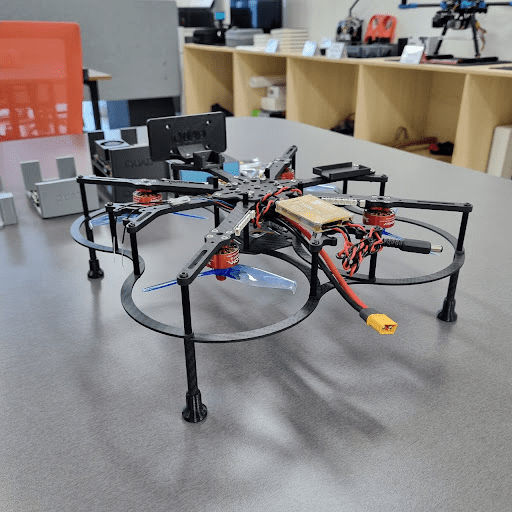
The core of a research vehicle is ‘reconfigurability.’ The Q250-V3 aims for a solder-less design, allowing researchers to build the system simply by connecting dedicated cables instead of wasting time with a soldering iron.
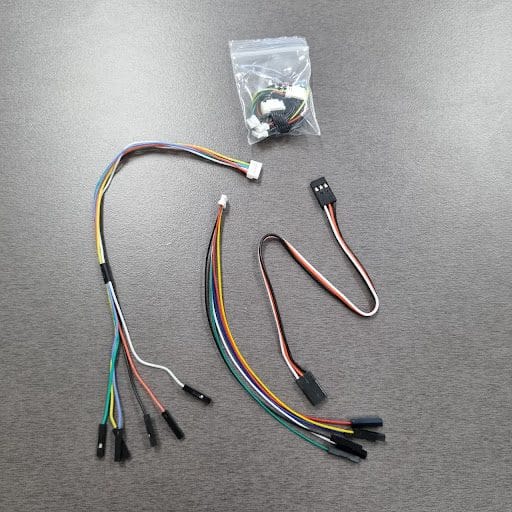

4. Technical Superiority of Q250-V3 II: Sensor and Companion Computer Integration Ecosystem
The success of autonomous drone research depends on how companion computers (NVIDIA Jetson) and sensors (RealSense, LiDAR) are integrated physically and logically.
4.1. 3D Printing-Based Modular Mount System
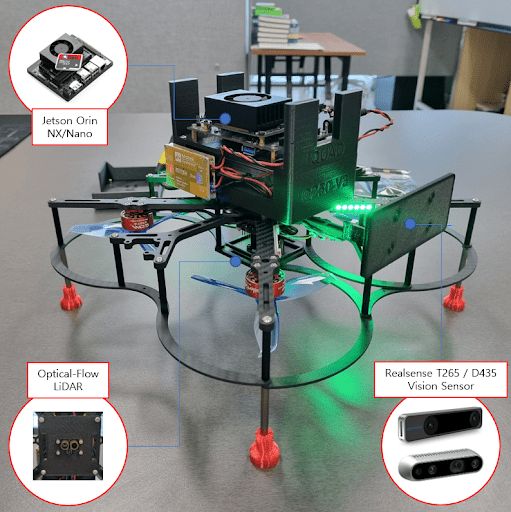
The Q250-V3 provides dedicated 3D-printed mounts for immediate attachment of various computing modules such as Jetson Orin Nano and Raspberry Pi 4/5. Furthermore, it includes dedicated brackets to precisely fix vision sensors like Intel RealSense T265/D435 without mechanical errors, enhancing the precision of V-SLAM research.

4.2. Optical Flow Integration for Indoor Autonomous Flight
For research in indoor or tunnel environments where GPS signals are lost, it features a structure where an Optical-Flow LiDAR sensor can be standardly placed at the bottom. This allows researchers to implement precise indoor hovering immediately.
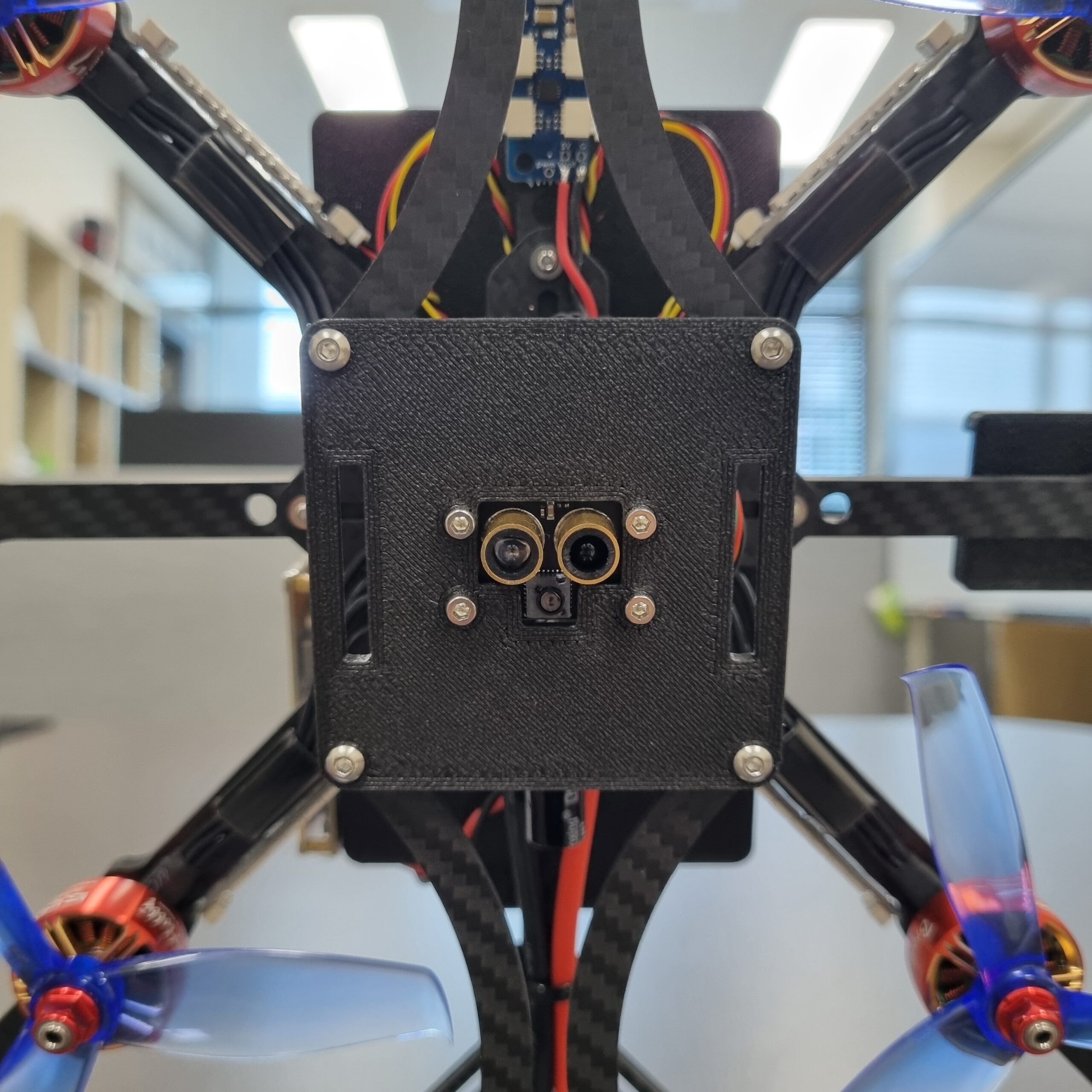
5. Software Ecosystem: Intelligent Images Beyond Hardware
The Q250-V3 is not just a collection of parts. QUAD Drone Lab provides an optimized software stack (SD card image) for research immediacy.
- Ubuntu 22.04 LTS & ROS2 Humble: Perfect support for the latest robot operating system standards.
- CUDA-Accelerated OpenCV & RealSense SDK: Pre-built high-speed image processing environment utilizing NVIDIA GPUs.
- Isaac ROS2 V-SLAM: Includes libraries to immediately run NVIDIA’s latest spatial recognition algorithms.
This ‘Plug & Play’ software environment allows researchers to reduce system setup time by at least two weeks.
6. Fair Judgment through Comparative Analysis: Research Efficiency of Q250-V3
When comparing the Q250-V3 with existing market products, this platform occupies a distinct competitive edge:
- Spatial Flexibility: It secures both the indoor operational safety that 500mm-class standard vehicles (X500) lack and the portability that 650mm-class vehicles (TD650) lack.
- Optimization of Computational Power: It is a unique form factor that combines the agility of a small racing drone with the powerful brain of a Jetson Orin.
- Learning and Research Resources: Beyond simple sales, we provide continuous technical support through GitBook-based Korean textbooks, YouTube tutorials, and a Facebook expert community.
7. Conclusion: An Excellent Choice Determining the ‘Speed’ and ‘Depth’ of Research
The essence of UAV research lies in the advancement of algorithms and the creation of value from data. While hardware assembly and solving software dependencies are necessary steps, they should not be the purpose of the research itself.
The QUAD Q250-V3 is a platform where the Lab has already experienced and resolved the unnecessary trial and error that researchers might face.
Stable hardware, a precise sensor integration system, and a proven software stack allow researchers to dive straight into essential problem-solving. From university capstone designs to in-depth V-SLAM research for Master’s and PhD students, and industrial autonomous prototyping for companies, the Q250-V3 will prove your results fastest as a ‘research partner’ beyond just being a drone.
The essence pursued by QUAD Drone Lab is to build a research-immersive environment where researchers can focus solely on innovative algorithm development and data value creation without being hindered by hardware limitations. We aim for a unique ecosystem that lowers the entry barrier to research by providing a proven technology stack and educational resources.
Starting with this introduction to the Q250-V3, we plan to serialize various special-purpose platform lineups and share practical seminar materials. Thank you.

Author: Aiden, Marketing Director of QUAD Drone Lab.
Date: February 8, 2026
![[하이브리드 항법 시스템: 제2편] PX4 자율 항법의 원리와 Gazebo SITL 시뮬레이터 세팅](https://quad-drone-lab.co.kr/wp-content/uploads/2026/04/PX4EKF2-Architecture-768x429.jpg)
![[ROS2 Mastery Part 3] A Guide to Creating Your First ROS2 Package and Programming a Python Node](https://quad-drone-lab.co.kr/wp-content/uploads/2026/05/0507_인포그래픽-768x512.png)
![[Hybrid Navigation System Series Part 1: Overview] Flying Hundreds of Kilometers Without GPS? Learning a Hybrid Navigation System from WWII Pilots](https://quad-drone-lab.co.kr/wp-content/uploads/2026/04/컴패니언-컴퓨터-기반의-AI-지형지물-보정-768x419.jpg)
![[Everything About Drone Batteries] Part 1: Drone Battery Fundamentals and Chemical Characteristics: LiPo vs. Li-Ion](https://quad-drone-lab.co.kr/wp-content/uploads/2026/04/Drone-Battery-Anatomy-and-Assembly-768x429.jpg)
![[MAVSDK C++ Part 4] Building Your Own App: Project Setup and Drone Connection](https://quad-drone-lab.co.kr/wp-content/uploads/2026/03/0314_인포그래피-768x512.png)